



Python · Rust · How it compares · When to use something else · API reference · Benchmarks
Ten million 768-dimensional embeddings take 31 GB of RAM as float32. turbovec holds them in 4 GB and searches them 4.4× faster than FAISS, at matching recall.
turbovec is an in-process vector index for Python and Rust. It stores each vector at 2 or 4 bits per dimension using Google Research's TurboQuant and searches that compressed form directly with agent-optimised SIMD kernels.
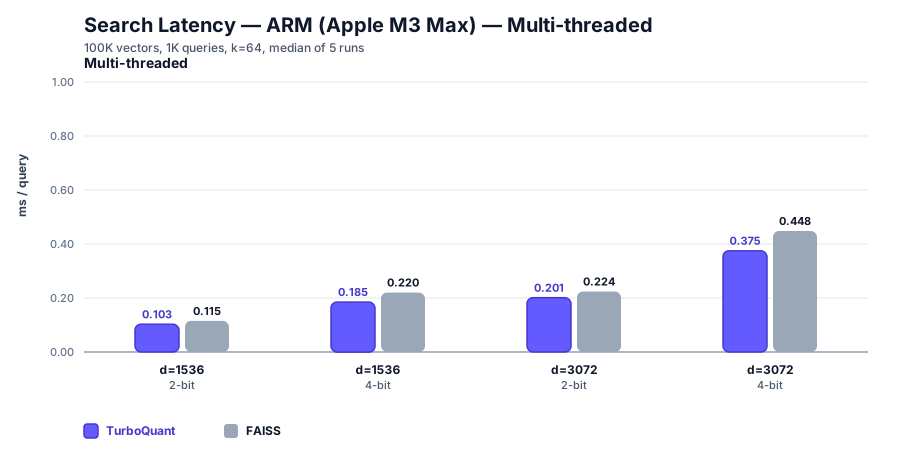
- Fast. 4.4× FAISS FastScan at 4-bit and 2.2× at 2-bit, on ARM and x86. A staged search scans one bit plane and rescores the shortlist exactly.
- Low memory. 7.8× smaller than float32 at 4-bit, 15.5× at 2-bit, at the same recall as FAISS.
- Online. No training step, no rebuilds: the codebook comes from the maths, not your data. Add a vector and it is searchable; remove one in microseconds.
- Incremental.
sync(path)writes only what changed since the last call — one fsync, crash-safe at any byte, milliseconds however large the index. - Local. A library, not a service: nothing leaves your process. Pair it with an open-source embedding model for a fully offline stack.
- Filtered. Pass an allowlist of ids or a bitmask; the kernel skips what the filter excludes and returns up to
kresults from the allowed set.
pip install turbovecimport numpy as np
from turbovec import TurboQuantIndex
vectors = np.load("embeddings.npy").astype(np.float32) # shape (n, 1536)
index = TurboQuantIndex(dim=1536, bit_width=4)
index.add(vectors)
scores, indices = index.search(vectors[:1], k=5)
print(indices) # [[ 0 86544 3385 84492 24967]] int64 slot positions
print(scores.shape) # (1, 5) float32 inner products
index.sync("index.tv") # first sync writes the file
index.add(more_vectors)
index.sync("index.tv") # later syncs write just the change, durably
index = TurboQuantIndex.load("index.tv") # loads either a sync'd or a write() fileInputs are 2-D float32 arrays of shape (n, dim); other dtypes raise rather than silently convert. Scores are inner products, so normalise your vectors if you want cosine similarity.
Need ids that survive deletes? IdMapIndex keys everything by your own uint64 ids:
from turbovec import IdMapIndex

index = IdMapIndex(dim=1536, bit_width=4)
index.add_with_ids(vectors, ids)               # ids: uint64 array, one per row

scores, ids = index.search(query, k=10)        # your ids, not slot positions
index.remove(1002)                             # O(1)

# Filter: only ids another system approved — a SQL predicate, an ACL, a time window.
allowed = np.array([1001, 1003, 1042], dtype=np.uint64)
scores, ids = index.search(query, k=10, allowlist=allowed)   # shape (1, min(k, 3))
Framework integrations are drop-in replacements for each framework's in-memory store — same public surface, same persistence, same retriever wiring:
LangChain (pip install turbovec[langchain]) ·
LlamaIndex (turbovec[llama-index]) ·
Haystack (turbovec[haystack]) ·
Agno (turbovec[agno]).
cargo add turbovecuse turbovec::{IdMapIndex, TurboQuantIndex};
let mut index = TurboQuantIndex::new(1536, 4)?;
index.add(&vectors); // &[f32], row-major, n × 1536
let results = index.search(&queries, 10); // scores and slot indices, nq × 10
index.write("index.tv")?;
let index = TurboQuantIndex::load("index.tv")?;
let mut ids = IdMapIndex::new(1536, 4)?;
ids.add_with_ids(&vectors, &[1001, 1002, 1003])?;
let (scores, found) = ids.search(&queries, 10);
ids.remove(1002);The Rust API mirrors the Python one; docs/api.md covers both, including the file formats, sync(), calibration and the staged search.
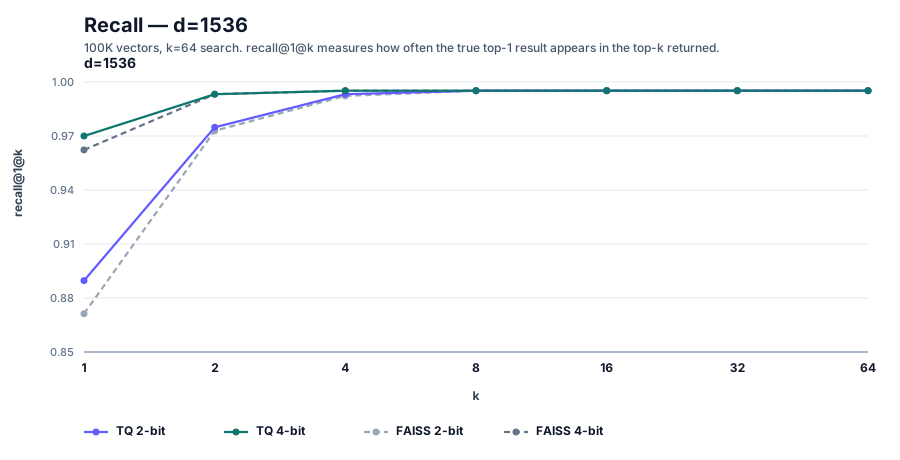
All figures: 100K OpenAI embeddings (d=1536 and d=3072) and GloVe (d=200), k=64, 1K queries, median of 5 runs, on a GCP c4a-standard-8 (ARM) and c3-standard-8 (x86), against FAISS at a matched bit rate. Scripts, raw JSON and every chart are in docs/benchmarks.md.
| turbovec | FAISS | ||
|---|---|---|---|
| Search, 4-bit | 3.8–5.1× faster across the eight cells (ARM 4.0×, x86 4.9×) | IndexPQFastScan |
every cell |
| Search, 2-bit | 1.8–2.5× faster (ARM 2.05×, x86 2.35×) | IndexPQFastScan |
every cell |
| Recall@1, OpenAI | 0.959 / 0.981 at 4-bit, 0.901 / 0.931 at 2-bit (d=1536 / d=3072) | 0.966 / 0.971, 0.876 / 0.911 | IndexPQ, m matched to bit rate |
| Recall@1, GloVe d=200 | 0.860 at 4-bit, 0.572 at 2-bit | 0.842, 0.565 | IndexPQ, m matched to bit rate |
| Memory, d=1536 | 75 MB at 4-bit, 38 MB at 2-bit | 586 MB float32 | 7.8× / 15.5× |
Single add() |
7.9–21.7 µs | 6.3–12.6× slower | into a trained, populated index |
remove(id) |
1.4–5.8 µs | 0.19–1.03 s | FAISS repacks all codes per call |
| Whole-file save | 1.0–1.4× slower than FAISS | write_index |
turbovec fsyncs and renames atomically |
| Load → first search | 1.0–1.5× slower than FAISS | read_index |
40 vs 31 ms at d=1536 4-bit on x86 |
Both always return the true nearest neighbour within the first 8 results on the OpenAI corpora. The full suite — every chart, the raw JSON and the scripts to re-run it — is in docs/benchmarks.md.
- You need a graph index. turbovec scans every vector. At 100K vectors a query costs 0.13–0.25 ms on all eight cores of the benchmark boxes and 0.5–2.0 ms on one thread (k=64, 1,000-query batches, d=1536 to d=3072), and the cost grows linearly with the corpus. For hundreds of millions of vectors behind strict latency, an HNSW or IVF index in front of it is the right shape, and turbovec is not one.
- You need exact float results. Quantization is lossy. On the OpenAI corpora the top result matches the float ground truth 96–98% of the time at 4-bit (90–93% at 2-bit) and is always within the first 8 returned; low-dimensional embeddings such as GloVe d=200 lose more. Check recall on a sample of your own data.
- You need a server. turbovec is a library with a file format. There is no network API, replication or multi-tenant service; the integrations above are how it slots into a stack that has those.
- Your vectors are not multiples of 8 wide, or wider than 16,384. Those are the dimension limits. Bit widths are 2 and 4.
Normalise each vector and store its length. Rotate every vector by one shared random orthogonal matrix, after which each coordinate follows a known distribution whatever the input. Quantise each coordinate with a Lloyd-Max codebook computed for that distribution — 4 levels at 2-bit, 16 at 4-bit — and bit-pack. At search time the query is rotated once and scored against the codebook with SIMD lookup tables; a per-vector scalar fixed at encode time removes the inner-product bias quantization introduces. An optional one-shot calibrate(sample) fits two scalars per coordinate for data that drifts from the asymptotic distribution (low-dimensional and word-vector embeddings gain most).
The full walk-through, with the maths and the references, is in docs/how-it-works.md.
Python wheel and Rust crate
pip install maturin
cd turbovec-python && maturin build --release && pip install target/wheels/*.whl
cargo build --releasex86_64 builds target x86-64-v2 (SSE4.2, Nehalem 2008+) via .cargo/config.toml; the AVX-512 and AVX2 kernels are #[target_feature]-gated and chosen at runtime with is_x86_feature_detected!, so one binary runs everywhere and uses what the CPU has. Running the benchmark suite is described in docs/benchmarks.md.
- TurboQuant: Online Vector Quantization with Near-optimal Distortion Rate (ICLR 2026) — the paper this implements
- RaBitQ: Quantizing High-Dimensional Vectors with a Theoretical Error Bound for Approximate Nearest Neighbor Search (SIGMOD 2024) — the per-vector length-renormalization correction
- FAISS Fast accumulation of PQ and AQ codes — turbovec's x86 kernel adapts FastScan's pack layout, nibble-LUT scoring and u16 accumulator strategy